
Modern Dealership Vehicle Merchandising Field Guide
Photography, staging, vehicle information and quality standards for the modern automotive shopper.
Modern vehicle merchandising should help a shopper understand the exact vehicle quickly and confidently. That requires more than a large photo count. Dealerships need a repeatable standard for vehicle preparation, image sequence, condition disclosure, verified data, useful descriptions and short-form video so every VIN is recognizable, complete, accurate, consistent and useful.
Use a repeatable photography sequence instead of improvising the gallery VIN by VIN.
Keep the master image set clean and natural so the vehicle remains the information source.
Verify material vehicle facts: trim, mileage, price and equipment should be confirmed, not inferred.
Represent meaningful condition. A disclosed imperfection creates less distrust than a discovered one.
Audit live inventory routinely so the standard becomes an operating system, not a one-time cleanup.
Printable Worksheets Your Team Can Use This Week
Each page is a one-sheet standard with the goal, a checklist, next actions and a success measure.
Every Vehicle Should Be Easy to Understand
A great merchandising process does not try to make every vehicle look expensive. It makes every vehicle easier to evaluate.
The field guide establishes five expectations for every live VIN: recognizable, complete, accurate, consistent and useful.
The shopper should immediately understand what the vehicle is, see the areas that matter, trust the facts being presented, move from VIN to VIN without relearning the gallery, and receive information that actually helps make a decision.
The objective is confidence, not concealment.
Build a Repeatable Visual Walkaround
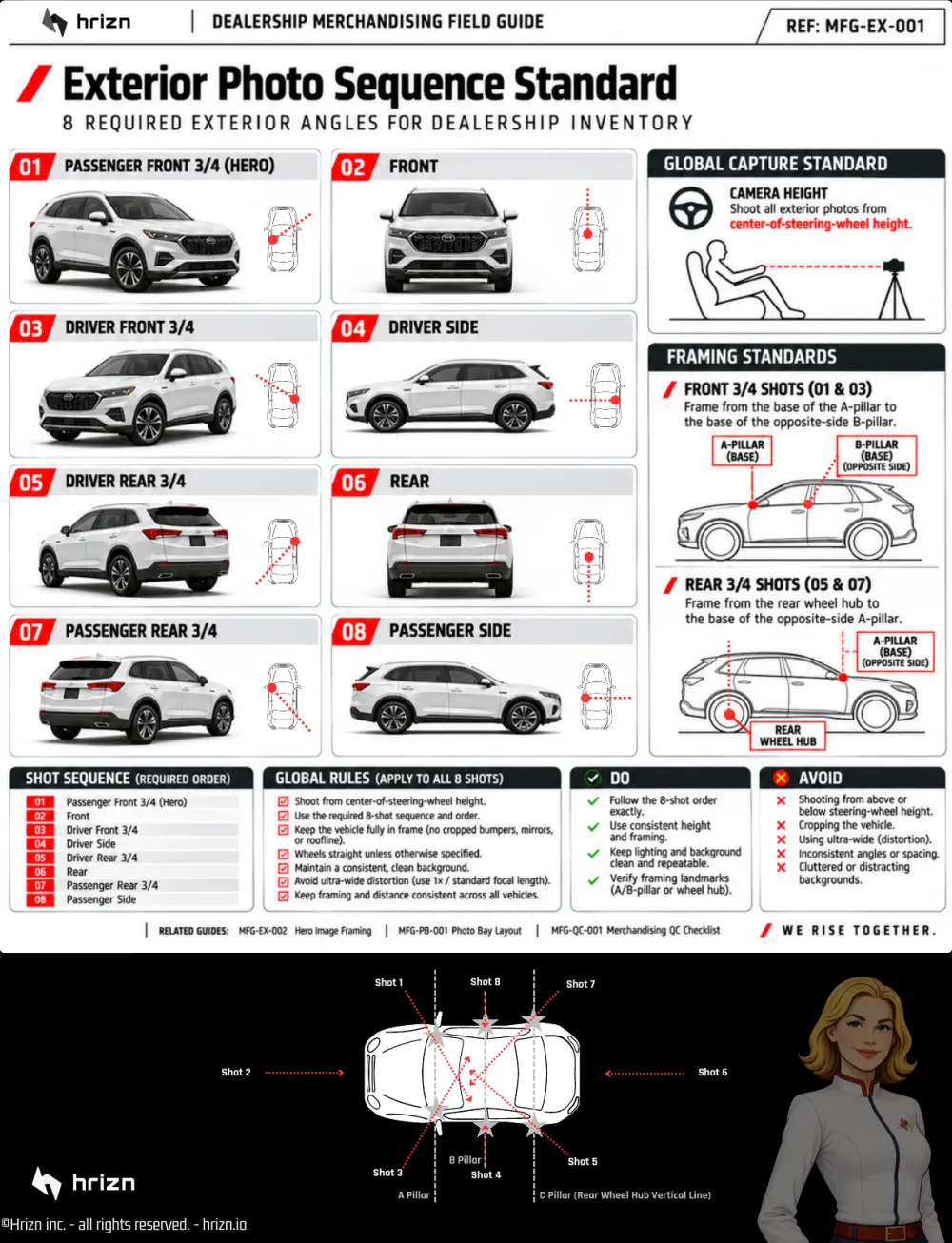
The playbook covers vehicle preparation, dedicated photo-bay targets, outdoor alternatives, smartphone and dedicated-camera guidance, image specifications and the required exterior sequence.
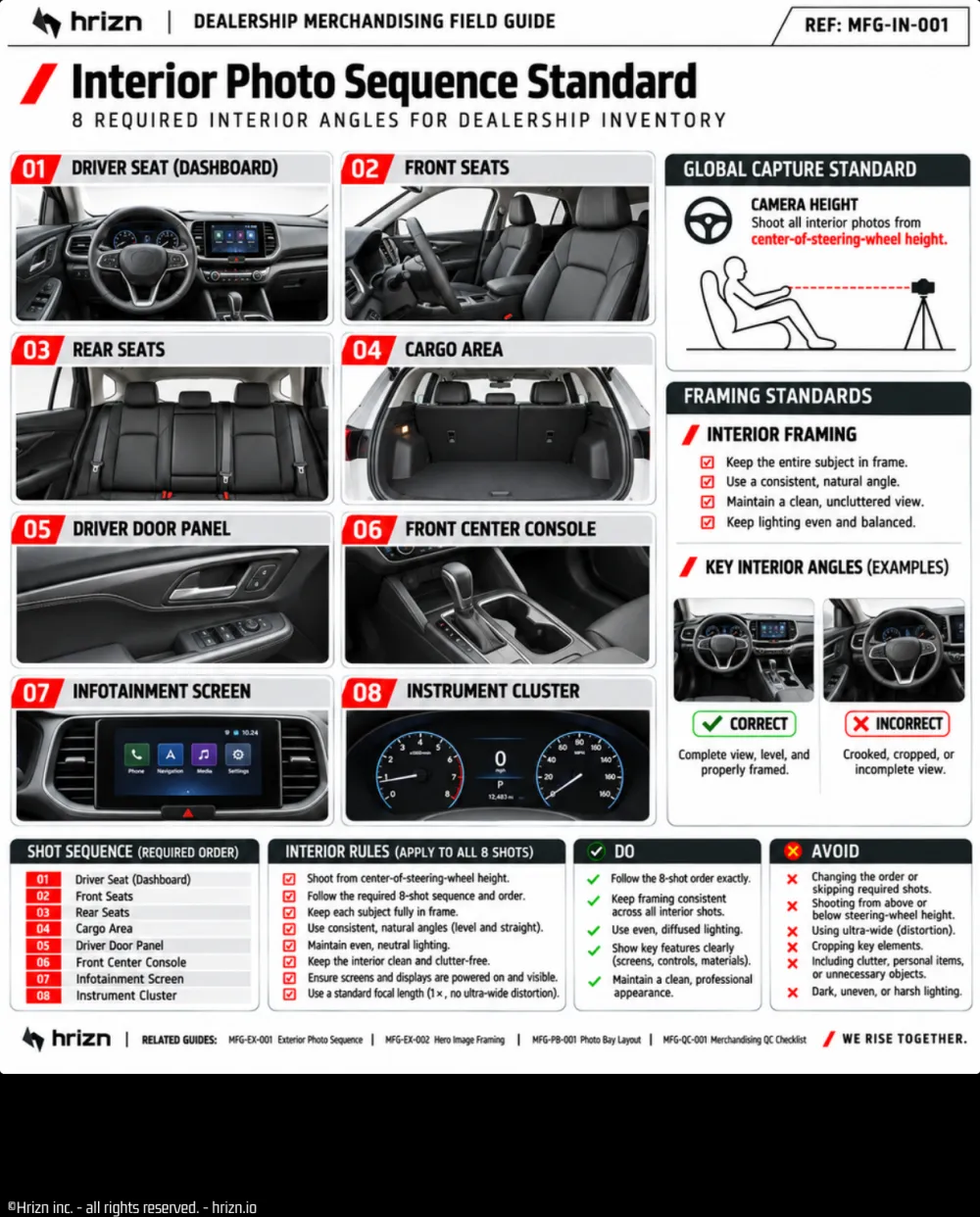
The exterior standard begins with a front driver-side three-quarter hero and continues through a complete eight-angle walkaround. Interior and detail photography then documents the cockpit, cluster, infotainment, seating, cargo space, meaningful equipment and relevant condition.
The goal is not to maximize photo count. The goal is to prevent the customer from mentally reconstructing a vehicle the dealership could have shown clearly.
Written and Machine-Readable Merchandising Have the Same Job
Descriptions should identify the vehicle, differentiate the configuration, contextualize why the equipment matters and remain grounded in verified facts.
The same discipline applies to the underlying data. VIN, year, make, model, trim, body style, drivetrain, fuel type, mileage, price, colors, certification, equipment, image association and current availability all contribute to the customer experience.
Do not compensate for inaccurate source data with prettier prose.
The 60-Second Walkaround Standard
The downloadable guide includes a repeatable short-form video structure:
- Identify the vehicle.
- Show one useful exterior differentiator.
- Demonstrate the interior or configuration customers actually ask about.
- Explain a real use case.
- Add one piece of human insight.
- Close with a natural next step.
The salesperson should not sound like an announcer.
The expert should sound like an expert.
Score the Merchandising Before You Promote It
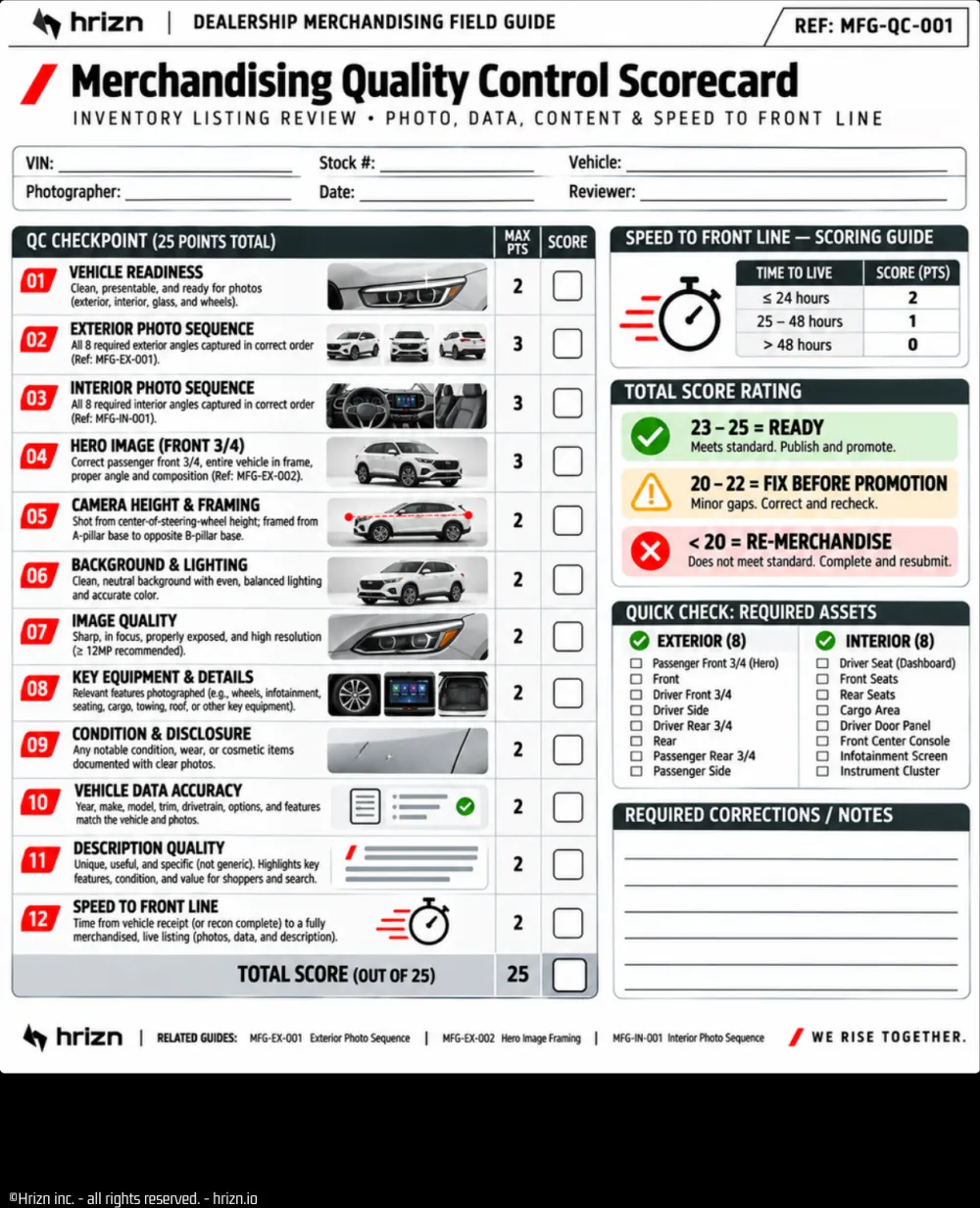
The field guide includes a 25-point quality-control audit covering vehicle readiness, photography, vehicle information and written merchandising.
23–25
Ready.
20–22
Fix before promotion.
Below 20
Re-merchandise.
The purpose of the score is not administrative perfection. It is to identify where the customer is still being asked to work too hard.
Start With Ten Live VINs
- Pick ten live vehicles.
- Score them using the 25-point audit.
- Identify the five weakest.
- Re-stage, re-photograph and rewrite those five.
- Compare the before and after with the sales and merchandising team.
Then repeat the process. The objective is not a one-time inventory cleanup. It is a merchandising operating system.
Get the Complete Vehicle Merchandising Field Guide
The full photo sequence, image specifications, vehicle-data checklist, 60-second walkaround script and the 25-point quality-control audit, ready to use on your live inventory.
Download the Vehicle Merchandising Field GuideVehicle Merchandising FAQ
Does a dealership need a dedicated photo bay?
No. A controlled bay improves repeatability, but a dealership can create a strong standard outdoors by choosing one predictable location with clean sightlines, soft light and enough working distance to avoid distortion.
Is a smartphone good enough for inventory photography?
Yes. A current flagship or recent-generation smartphone can produce excellent inventory photography when the process is controlled. Consistent lens choice, exposure, framing and vehicle position matter more than complicated equipment.
Should used-vehicle damage be photographed?
Meaningful visible condition should be represented clearly. The goal is not to create a damage inspection report; it is to eliminate avoidable surprises.
How many photos should a vehicle have?
The right number is the number required to answer the shopper’s meaningful visual questions without unnecessary duplication. Completeness matters more than raw volume.
Continue the 2027 Customer Experience Reset
Read the Strategy Behind This Resource
Make the Inventory Easy to UnderstandExplore the Complete Thought Leadership Series
The Dealership Customers Choose AgainExplore All Customer Experience Resources
2027 Dealership Customer Experience Reset Resource LibraryNext Operating Resource
Dealership Trust & Transaction Clarity PlaybookMerchandise Every VIN Like Someone Will Read It. They Will.
Hrizn turns verified vehicle data and your team's expertise into accurate, useful inventory content that shoppers and AI search can both trust.
That advantage grows every month.
We Rise Together.