
Dealership Friction Audit & Omnichannel Continuity Playbook
Find the restart moments, broken handoffs and context loss that make customers navigate the dealership's internal structure.
A dealership friction audit follows the customer across digital and physical touchpoints and marks every place they must repeat information, re-establish intent, wait without context, reconcile conflicting answers or restart a process another department already began. Omnichannel continuity means useful context survives the handoff so each step feels like progress instead of a reset.
Audit the journey across departments. Departmental performance can look healthy while the experience still breaks between teams.
Mark every repeated question. Repetition is often evidence of context loss.
Define minimum useful context: the next person should receive what is necessary to continue the customer objective.
Respect permission boundaries. Separate appropriate access controls from preventable information loss.
Measure reconstruction work. Better continuity means less rebuilding for both the customer and the employee.
Printable Worksheets Your Team Can Use This Week
Each page is a one-sheet standard with the goal, a checklist, next actions and a success measure.
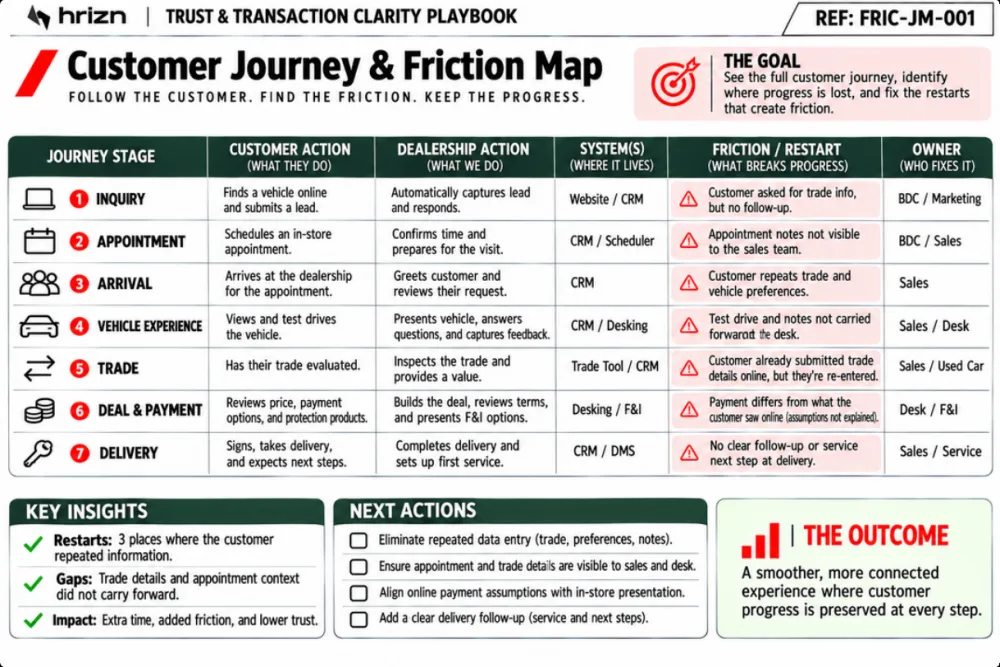
The Customer Experiences One Dealership
The dealership experiences marketing, website, BDC, sales, desk, finance, service, parts and multiple software systems. The customer mostly experiences whether anybody remembers what they already said.
Friction often hides between departmental metrics. The website may convert. The BDC may respond quickly. Sales may follow its process. Finance may complete the transaction correctly. Yet the customer can still experience repeated questions, inconsistent answers and lost context between every step.
The customer should not have to pay the integration tax for the dealership’s organizational structure.
Find the Restart Moments
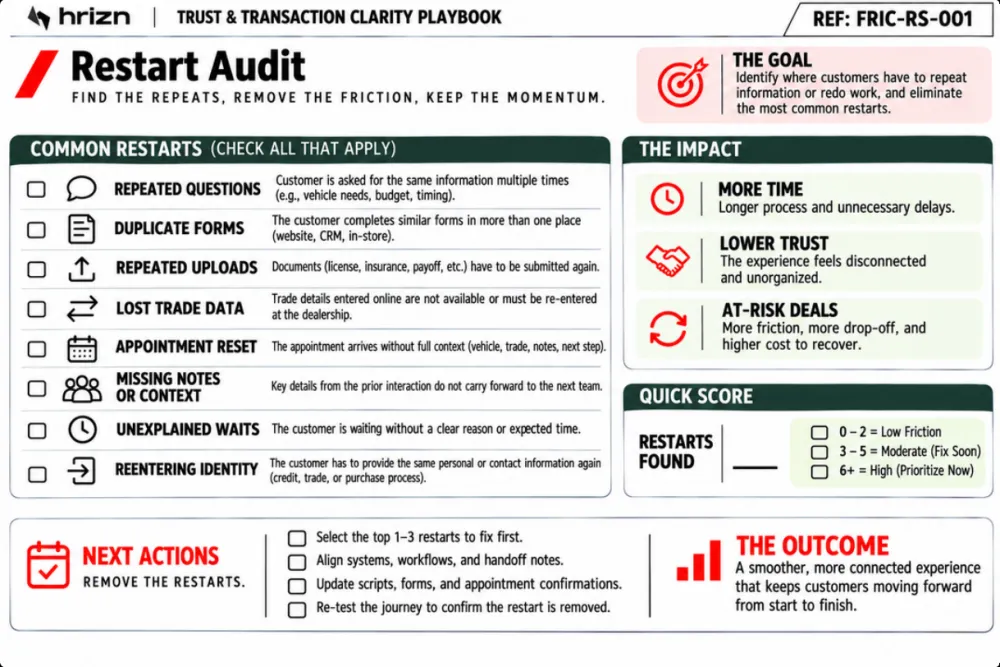
A restart moment occurs whenever a customer or employee must reconstruct information the dealership already possessed.
Examples include:
- Asking which vehicle a shopper wants after they already submitted the VIN.
- Making a customer repeat a trade story captured online.
- Losing the reason for a service visit.
- Reopening a settled product question.
- Sending follow-up that ignores the conversation that just occurred.
Mark these moments. They show where the experience itself is losing momentum.
Define the Minimum Useful Context for Every Handoff
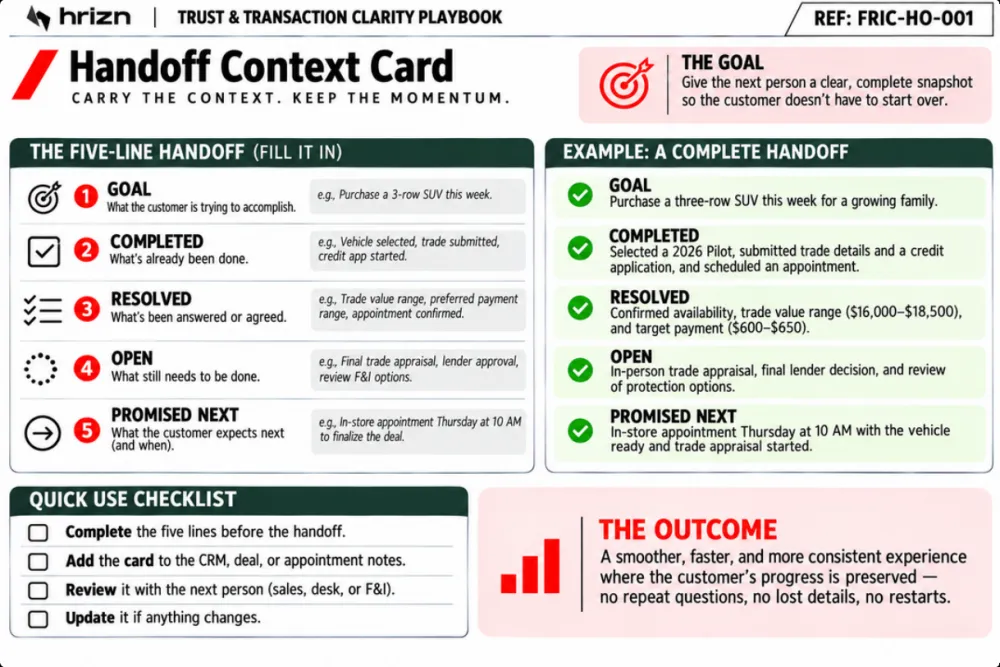
Continuity does not mean every employee should see every piece of information. It means the next responsible person receives the context required to continue the customer’s objective appropriately.
A practical handoff standard should preserve:
- What the customer is trying to accomplish.
- Which vehicle, service need or decision is involved.
- Important constraints or preferences already stated.
- What has already been explained or decided.
- What remains unresolved.
- Who currently owns the next step.
The standard should be small enough to use consistently and useful enough to prevent the next employee from beginning at zero.
Run the Dealership Friction Audit
- Select five to ten recent customer journeys.
- Map the meaningful touchpoints from initial research or inquiry through the latest completed step.
- Mark each channel and every change in employee or department.
- Circle every repeated question, unexplained wait, inconsistent answer and lost commitment.
- Identify where useful context existed but did not survive the handoff.
- Separate true policy or permission constraints from preventable workflow friction.
- Redesign the three highest-friction handoffs first.
The objective is not a perfect journey map. It is to find where the customer repeatedly pays for internal fragmentation.
The Monday Continuity Reset
Bring one real customer journey into the Monday operating meeting. Follow it across the dealership.
Ask where context disappeared, where the customer restarted and whether the next employee had enough information to continue the objective. Fix one handoff at a time.
Progress should survive the handoff.
Get the Complete Friction Audit & Continuity Playbook
The full journey audit, handoff standard and Monday continuity rhythm for finding and removing restart moments across website, BDC, showroom, finance, service and follow-up.
Download the Friction Audit & Omnichannel Continuity PlaybookFriction & Omnichannel Continuity FAQ
Is omnichannel continuity the same as having one CRM?
No. A shared system can help, but continuity is an operating outcome. Customers can still repeat themselves inside a single platform if the right context is not captured, transferred or used.
Does continuity mean every system must be integrated?
No. Start with the highest-value handoffs and the minimum useful context required to continue the customer objective. Some improvements are procedural before they are technical.
How do we know a handoff is working?
The next employee can continue the customer’s objective without asking the customer to reconstruct information the dealership should already know.
Where should a dealership start?
Start with high-frequency handoffs: digital lead to BDC, BDC to showroom, sales to finance, sales to delivery, service scheduling to advisor, and completed transaction to ownership follow-up.
Continue the 2027 Customer Experience Reset
Read the Strategy Behind This Resource
Make Every Step Feel Like ProgressExplore the Complete Thought Leadership Series
The Dealership Customers Choose AgainExplore All Customer Experience Resources
2027 Dealership Customer Experience Reset Resource LibraryNext Operating Resource
Frontline Human Advantage PlaybookEvery Step Should Feel Like Progress.
Hrizn gives shoppers clear, consistent answers before they ever reach your team, so fewer conversations start from zero and more of them start with intent.
That advantage grows every month.
We Rise Together.