
Dealership Trust & Transaction Clarity Playbook
A practical operating framework for making pricing, trade, payments, products, expectations and transaction changes easier for customers to understand.
Dealership trust improves when the customer can understand what they are agreeing to, what changed, why it changed and what happens next. Transaction clarity is not a promise that every number will remain static. It is an operating standard that makes pricing, trade values, payment assumptions, optional products, approvals and handoffs explainable instead of surprising.
Keep customer-facing numbers consistent: when the underlying assumptions are the same, the presented numbers should reconcile.
Explain changed inputs before changed outputs so the customer understands why a number moved.
Separate required from optional so products, choices and transaction requirements are distinguishable.
Set expectations before the customer asks: time, approvals, documentation and next steps should be visible.
Audit the whole transaction for places where customers must decode language or reconcile conflicting information.
Printable Worksheets Your Team Can Use This Week
Each page is a one-sheet standard with the goal, a checklist, next actions and a success measure.
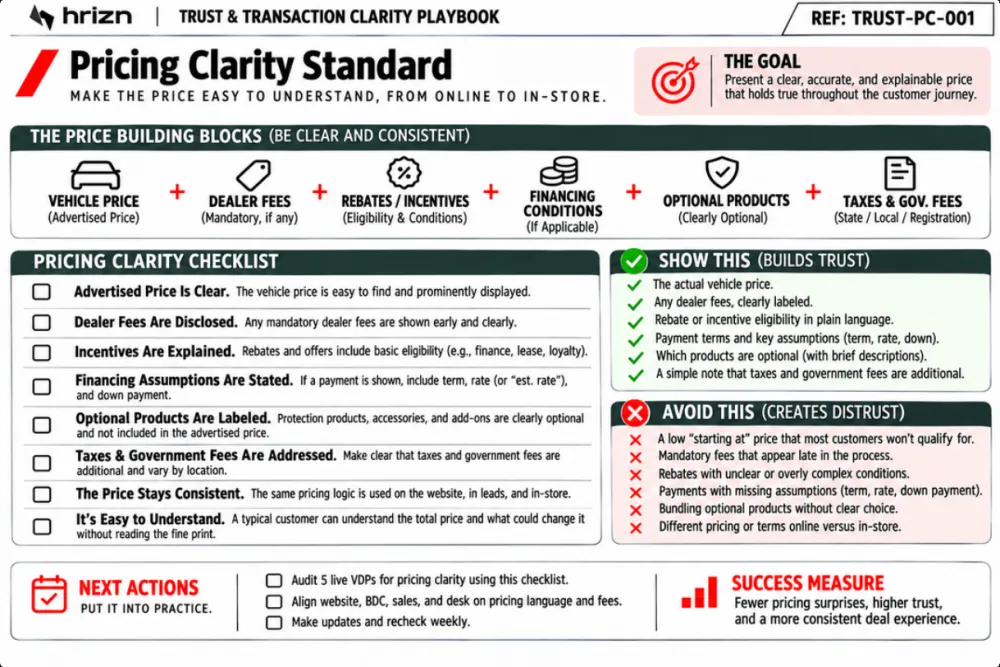
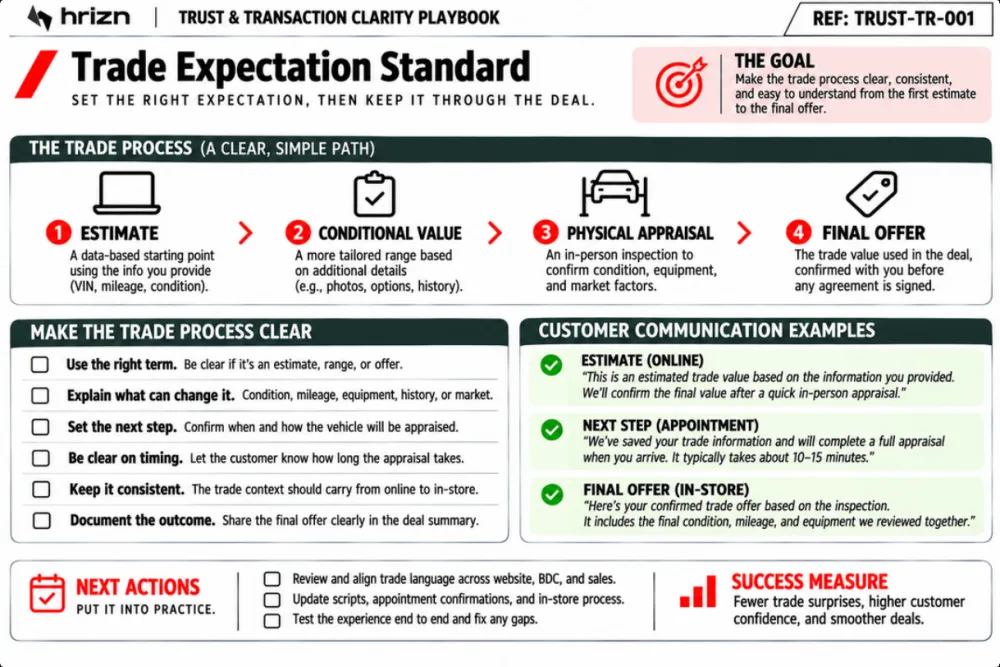
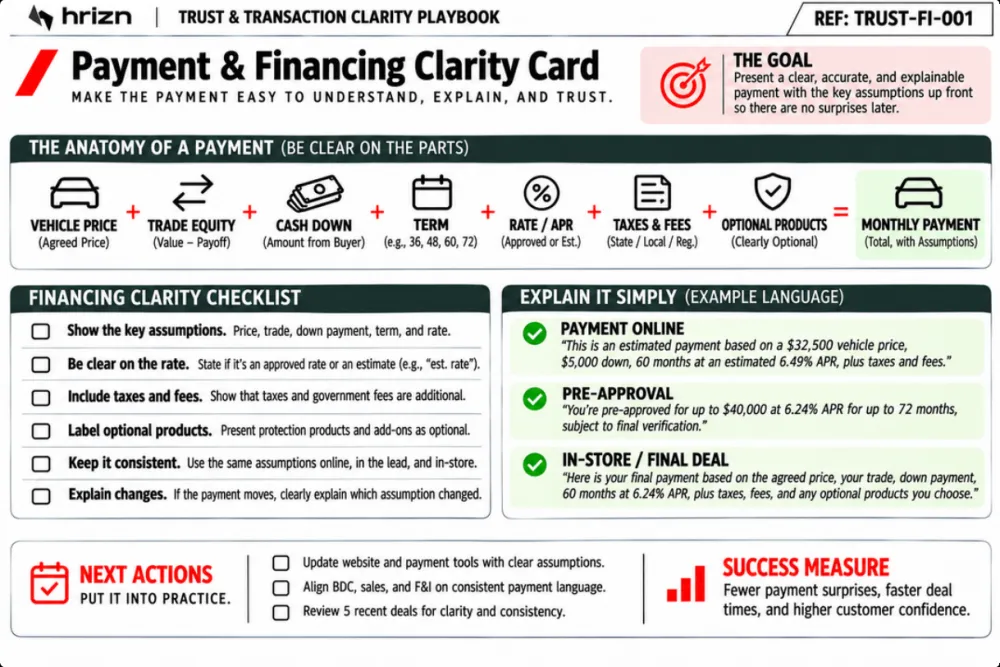
Trust Is the Absence of Unnecessary Surprise
Customers do not need every automotive transaction to be simple. Financing, trade values, taxes, incentives, lender requirements and optional products can create legitimate complexity. They do need that complexity to be explainable.
A strong transaction standard makes four things visible:
1
The number
2
The assumption behind the number
3
The reason for any change
4
The next decision the customer is being asked to make
Clarity does not require every number to stay the same. It requires the customer to understand why the number changed.
Make the Numbers Explainable
Pricing and payment friction usually appears when two valid numbers are presented without the assumptions that connect them.
A payment may change because term, rate, cash down, trade equity, taxes, fees, protection products or vehicle selection changed. A trade value may change because the physical vehicle differs materially from the information available online.
The operating question is not whether the dealership can defend the math after the customer objects. It is whether the customer can understand the math before distrust appears.
Make Expectations Visible Before They Become Friction
If the next step requires a credit decision, appraisal, manager approval, lender response, product presentation or document review, tell the customer what is happening and what they should expect.
Silence creates its own story.
A simple expectation standard should answer:
- What are we doing?
- Why are we doing it?
- How long should it reasonably take?
- What will happen when we return?
Protect Trust When Responsibility Changes Hands
A transaction can be clear at the salesperson’s desk and become confusing during the next handoff.
Before responsibility changes, transfer the customer’s known priorities, decisions already made, assumptions already discussed and unresolved questions. The next employee should not inadvertently reopen settled ground simply because the internal owner changed.
The customer experiences one transaction.
Run a Transaction Clarity Audit
- Identify every customer-facing number.
- Record the assumption behind each number.
- Mark every point where a number or expectation changed.
- Ask whether the reason was explained before the customer had to challenge it.
- Identify where optional and required elements became difficult to distinguish.
- Review handoffs for duplicated questions or lost commitments.
- Choose the three clarity gaps the store can remove immediately.

Get the Complete Trust & Transaction Clarity Playbook
The full operating standard for pricing, trade, payment, optional products, expectations and handoffs, with the transaction clarity audit ready to run on real deals.
Download the Trust & Transaction Clarity PlaybookTransaction Clarity FAQ
Does transaction clarity mean fixed pricing?
No. The principle applies regardless of pricing model. The goal is to make the customer understand the number, the assumptions behind it and why it changed when a material input changed.
Does this replace F&I compliance procedures?
No. This is a customer-experience and operating framework, not legal or regulatory advice. Existing compliance requirements and approved dealership procedures still govern the transaction.
Where should a dealership start?
Start with the moments that generate the most repeated explanation or customer surprise: advertised price, trade value, payment assumptions, time expectations, optional products and the sales-to-finance handoff.
Who owns transaction clarity?
Leadership sets the standard, but the customer experiences the combined work of marketing, sales, desk, finance and delivery. The operating owner should therefore be able to inspect the journey across those boundaries.
Continue the 2027 Customer Experience Reset
Read the Strategy Behind This Resource
Make the Deal Easy to TrustExplore the Complete Thought Leadership Series
The Dealership Customers Choose AgainExplore All Customer Experience Resources
2027 Dealership Customer Experience Reset Resource LibraryNext Operating Resource
Dealership Friction Audit & Omnichannel Continuity PlaybookThe Customer Should Understand the Deal Before They Question It.
Hrizn helps dealerships publish clear, consistent answers about pricing, financing, trade and the buying process, so shoppers arrive informed and the conversation starts further ahead.
That advantage grows every month.
We Rise Together.